

The rack mount chassis is the structural foundation of virtually every data center, telecommunications room, and industrial network installation — holding servers, switches, routers, firewalls, and storage arrays in standardized mounting positions within a 19-inch rack or a metric rack system. A rack mount chassis that is poorly manufactured — wrong dimensions, insufficient material, inadequate grounding, or poor thermal design — compromises the reliability of the equipment it houses and the uptime of the systems it supports. For procurement engineers, system integrators, and network equipment buyers specifying rack mount chassis for data equipment applications, understanding what separates professional rack mount chassis manufacturing from basic sheet metal fabrication is essential to sourcing enclosures that perform reliably in demanding data environments. This article covers rack mount chassis manufacturing from standards and materials through thermal design and supplier qualification.
The Standards Governing Rack Mount Chassis Manufacturing
Rack mount chassis dimensions are defined by two primary standards: ANSI/EIA-310-E in North America (defining the 19-inch rack system with a horizontal mounting space of 17.75 inches / 450.85 mm) and IEC 60297 (defining the metric equivalent in metric units). The rack mount chassis standard defines not just the width — which is the most recognized dimension — but also the mounting hole pattern, rack unit (U) height increments, mounting flange spacing, depth from front mounting plane to rear mounting plane, and the dimensional tolerances required for interoperability between chassis and rack from different manufacturers.
The rack unit (U) is the fundamental rack mount chassis dimension increment — one U equals 1.75 inches (44.45 mm) of vertical mounting space. A 1U rack mount chassis occupies 1.75 inches of vertical height; a 4U rack mount chassis occupies 7.0 inches. The rack mount chassis standard specifies not just the nominal dimension but the allowable deviation from nominal — in practice, a 4U rack mount chassis from any compliant manufacturer will fit in a 4U rack slot from any other compliant manufacturer, with adequate but not excessive clearance. This interchangeability — the result of decades of standardization — is what allows data center operators to mix rack mount chassis from multiple manufacturers in the same rack infrastructure.
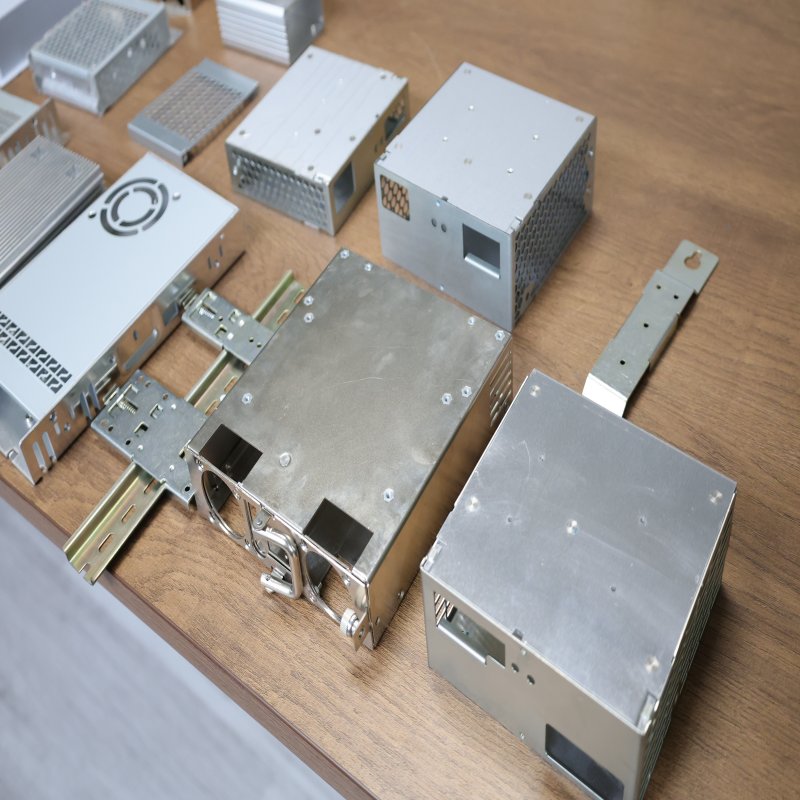
Metric Rack Standards in Rack Mount Chassis Manufacturing
IEC 60297-3-1 and related metric standards define a rack mount chassis system based on metric dimensions — 482.6 mm (19-inch) horizontal mounting with metric hole patterns and 44.45 mm (1U) vertical increments. While the 19-inch form factor is universal, the specific metric rack mount chassis standards (IEC 60297 series) are increasingly specified in new data center projects globally, particularly outside North America. A professional rack mount chassis manufacturing supplier should be able to produce chassis to either ANSI/EIA-310 or IEC 60297 dimensional standards with equivalent precision.
Materials and Structural Requirements in Rack Mount Chassis Manufacturing
The material selection for rack mount chassis manufacturing balances structural strength, weight, cost, and electromagnetic compatibility. The most common materials are cold-rolled carbon steel, aluminum, and stainless steel, with zinc-plated or powder-coated finishes for corrosion protection.
Cold-rolled steel is the dominant rack mount chassis material — providing the combination of structural stiffness, EMI shielding, and cost that suits most data equipment applications. Steel thickness in rack mount chassis manufacturing ranges from 1.0 mm (for lightweight 1U chassis) to 2.0 mm or more for heavy 4U and larger chassis that must support the weight of dense server or storage equipment. The rack mount chassis mounting flanges — the horizontal rails that engage with the rack's mounting holes — must be sufficiently thick and stiff to maintain dimensional accuracy under load: 2.0 mm minimum is standard for most rack mount chassis applications, with 2.5 to 3.0 mm used for heavy-duty chassis carrying dense storage arrays or uninterruptible power supplies.
Aluminum rack mount chassis is specified for weight-sensitive applications — portable network test equipment, mobile data systems, or rack mount chassis for airborne or vehicle-mounted installations where the weight premium of steel is not acceptable. Aluminum provides adequate stiffness for moderate-weight equipment but requires thicker sections than steel to achieve equivalent stiffness (approximately 1.5x the thickness for equal stiffness). An extruded aluminum rack mount chassis profile — with integrated mounting rails and cooling vents fabricated as part of the extrusion — can provide excellent stiffness-to-weight ratio while reducing the number of fabricated joints.
Surface Finish and Corrosion Protection in Rack Mount Chassis Manufacturing
The surface finish on a rack mount chassis serves both cosmetic and functional purposes. Powder coating is the standard finish for steel rack mount chassis — providing uniform coverage, good edge coverage, and resistance to scratching during installation and maintenance. The standard finish color for rack mount chassis is black (RAL 9005 or equivalent), which is the conventional color for data equipment and provides good contrast for labels, LED indicators, and port markings. Custom colors for rack mount chassis applications — for branding, color-coding by system type, or aesthetic integration — are available as an option from most rack mount chassis manufacturing suppliers, typically with a minimum order quantity and longer lead time.
Thermal Design in Rack Mount Chassis Manufacturing
Thermal management is a primary design driver for rack mount chassis serving high-power data equipment. The heat output of modern servers and network equipment — driven by increasing processor density and network bandwidth — can exceed 200 to 400 watts per rack unit in high-density configurations. The rack mount chassis must provide adequate airflow paths — front-to-rear ventilation with minimal obstruction — to allow the fans in the housed equipment to draw cool air from the front and exhaust warm air to the rear without recirculation.
The rack mount chassis manufacturing design process should include thermal analysis for high-power applications — particularly for rack mount chassis serving blade servers, GPU compute nodes, or high-density storage arrays where the internal heat load is significant. A CFD (computational fluid dynamics) analysis or physical thermal test of the rack mount chassis design under the expected thermal load conditions verifies that the ventilation design provides adequate cooling without hot spots. For rack mount chassis in sealed or partially sealed configurations — such as outdoor network enclosures — integrated cooling solutions including filtered fans, thermoelectric coolers, or heat exchangers may be required.
Fan and Ventilation Design in Rack Mount Chassis Manufacturing
For rack mount chassis designs that include integral cooling fans — as distinguished from chassis that rely entirely on the equipment's internal fans — the fan placement, size, and airflow rate must be selected based on the rack mount chassis internal heat load and the desired temperature rise across the chassis. The airflow rate (CFM or m³/h) required for a rack mount chassis is calculated from the heat load, the allowable temperature rise, and the ambient air temperature. Fan noise — measured in dB(A) — is a relevant consideration for rack mount chassis in office or residential environments, where the cumulative fan noise from multiple chassis in a network room may exceed acceptable levels.
EMI and Grounding in Rack Mount Chassis Manufacturing
The rack mount chassis must provide EMI shielding for the equipment it houses — reducing electromagnetic emissions that could interfere with adjacent equipment and attenuating external EMI that could disrupt sensitive electronics. Steel rack mount chassis provides inherent EMI shielding because the continuous steel shell attenuates electromagnetic radiation across a wide frequency range. The shielding effectiveness of a steel rack mount chassis depends on the material thickness (thicker steel provides better shielding), the electrical continuity at joints and seams (spot-welded or riveted seams with inadequate contact pressure have higher resistance and reduced shielding), and the integrity of cable entry points (unfiltered cable penetrations are EMI leakage paths).
Grounding in rack mount chassis manufacturing follows the requirement for a continuous low-impedance ground path from every conductive surface to the ground terminal — specified in IEC 60950-1 (information technology equipment safety) and UL 60950-1. The rack mount chassis ground connection must be designed to handle fault currents without overheating, to maintain ground potential under RF conditions (RF-bonded grounds require direct metal-to-metal contact without paint or coating at the bond point), and to survive mechanical vibration without loosening. A rack mount chassis manufacturing supplier with documented ground continuity testing — measuring the resistance from every accessible conductive surface to the ground terminal — provides evidence of a properly designed grounding system.
Quality Standards and Testing for Rack Mount Chassis Manufacturing
Professional rack mount chassis manufacturing includes dimensional verification, structural testing, and electrical safety testing. Dimensional testing of a rack mount chassis verifies that the critical dimensions — rack mounting flange spacing, EIA unit height increment, front-to-rear mounting depth, and overall width — are within the tolerances specified in ANSI/EIA-310 or IEC 60297. The critical dimensions of a rack mount chassis should be verified on the first article and periodically during production runs to confirm that tooling wear or process changes have not shifted dimensions outside tolerance.
Structural testing for rack mount chassis manufacturing includes static load testing — applying the rated load to the mounting flanges and verifying that the chassis does not deflect beyond the specified maximum — and mechanical impact testing per IEC 60068-2-75 for rack mount chassis that must meet IK mechanical impact ratings. For rack mount chassis serving telecommunications or outdoor applications, additional environmental testing may be required — including humidity cycling, salt spray for marine environments, and UV exposure testing for outdoor rack mount chassis installations.
Safety Testing Requirements for Rack Mount Chassis
Electrical safety testing for rack mount chassis serving data equipment falls under IEC 60950-1 (or the newer IEC 62368-1 for audio/video and information technology equipment) and UL 60950-1 for North American markets. The relevant tests for rack mount chassis manufacturing include: dielectric strength test — verifying that the insulation between live parts and the chassis body withstands the rated test voltage; ground continuity test — verifying that all accessible conductive surfaces are bonded to the ground terminal with resistance below the maximum specified; and insulation resistance test — measuring the insulation resistance between circuits and the chassis ground.
Supplier Qualification for Rack Mount Chassis Manufacturing
Qualifying a rack mount chassis manufacturing supplier requires verifying dimensional capability, material and finish quality, EMI and grounding design competence, and documentation infrastructure. The key qualification criteria for rack mount chassis manufacturing include: dimensional capability — verify that the supplier can hold ANSI/EIA-310 or IEC 60297 tolerances on the critical mounting dimensions; tooling capability — confirm that the supplier has tooling (progressive dies, CNC bending dies, jigs) that produces consistent dimensions across production runs; surface finish quality — review finish samples to confirm uniform coverage, adequate thickness, and adhesion; and testing capability — confirm that the supplier can perform ground continuity testing and dielectric testing on production units, or negotiate testing as a line item in the rack mount chassis manufacturing specification.
The most reliable qualification evidence for rack mount chassis manufacturing is a first article inspection report from a comparable previous project — verifying that the supplier can produce a rack mount chassis that meets the dimensional, structural, and electrical requirements with the documentation to prove it. A rack mount chassis manufacturing supplier that cannot produce FAI documentation from comparable work is a supplier whose quality system has not been validated on the specific product type.
Conclusion
Rack mount chassis manufacturing for data equipment is a precision sheet metal fabrication discipline governed by ANSI/EIA-310 and IEC 60297 dimensional standards, with additional requirements for thermal management, EMI shielding, and electrical safety testing. Getting rack mount chassis manufacturing right means specifying the exact standard (ANSI/EIA-310 or IEC 60297), defining the material and finish requirements based on the installation environment, including thermal analysis requirements for high-density equipment, requiring ground continuity and dielectric testing documentation from the supplier, and qualifying the supplier on dimensional capability and first article performance rather than catalog pricing alone. A professional rack mount chassis manufacturing supplier with documented dimensional control, tooling management, and testing capability delivers enclosures that fit correctly, perform reliably, and maintain safety compliance throughout the equipment's operational life. When sourcing rack mount chassis manufacturing for data equipment, include dimensional tolerances, material specifications, thermal requirements, and testing documentation in the procurement specification — the investment in detailed requirements produces rack mount chassis products that integrate cleanly and perform reliably in demanding data environments.
FAQ
What is the difference between ANSI/EIA-310 and IEC 60297 for rack mount chassis?
ANSI/EIA-310 (19-inch rack system) and IEC 60297 (metric rack system) define equivalent rack mount chassis dimensions — 19-inch horizontal mounting space, 1.75-inch (44.45 mm) rack unit vertical increments — using imperial versus metric units respectively. Both standards produce interchangeable rack mount chassis products with equivalent dimensional precision.
What material is best for rack mount chassis serving high-power servers?
Cold-rolled steel is the standard rack mount chassis material for high-power data equipment, providing the structural stiffness, EMI shielding, and thermal conductivity that data equipment applications require. Aluminum is specified for rack mount chassis in weight-sensitive or portable applications.
What thermal testing should rack mount chassis manufacturing include?
For rack mount chassis serving high-density equipment, thermal testing or CFD analysis verifies that the ventilation design maintains internal temperatures within equipment ratings. Standard rack mount chassis thermal qualification measures temperature rise at the inlet and outlet of the chassis under the rated heat load.
What safety tests apply to rack mount chassis manufacturing?
Rack mount chassis for data equipment must comply with IEC 60950-1 or IEC 62368-1, including dielectric strength testing, ground continuity testing, and insulation resistance testing to verify the chassis meets electrical safety requirements before equipment installation.
References
1. ANSI/EIA-310-E, "Racks, Panels, and Associated Equipment," Electronic Industries Alliance, Arlington, 1992.
2. IEC 60297-3-1:2008, "Mechanical Structures for Electronic Equipment — Dimensions of Mechanical Structures of the 482.6 mm (19-in) Series," International Electrotechnical Commission, Geneva, 2008.
3. IEC 60950-1:2005+AMD1:2009+AMD2:2013 CSV, "Information Technology Equipment — Safety — Part 1: General Requirements," International Electrotechnical Commission, Geneva, 2014.
4. IEC 62368-1:2018, "Audio/Video, Information and Communication Technology Equipment — Part 1: Safety Requirements," International Electrotechnical Commission, Geneva, 2018.
5. IEEE Std 299-2006, "IEEE Standard Method for Measuring the Effectiveness of Electromagnetic Shielding Enclosures," Institute of Electrical and Electronics Engineers, Piscataway, 2006.