

An industrial control panel cabinet protects the controllers, drives, and protection devices that run a plant's machinery. The single most consequential design decision behind that protection is the enclosure material. The material of an industrial control panel cabinet determines how long the cabinet survives its environment, how well it shields internal electronics from interference and impact, how much it weighs and costs, and what finishing and maintenance it requires over its service life. Choosing the wrong material for an industrial control panel cabinet is not a cosmetic mistake — it is a reliability failure that shows up as corrosion, seal failure, or structural deformation after the equipment is installed and operating. This guide walks through the material options for an industrial control panel cabinet and the selection logic that matches each material to the right application.
Why Material Selection Matters for an Industrial Control Panel Cabinet
The material of an industrial control panel cabinet is a constraint on every other design parameter. A carbon steel industrial control panel cabinet is strong and economical but must be coated to resist corrosion; a stainless steel industrial control panel cabinet resists corrosion without coating but costs more; an aluminum industrial control panel cabinet is light and conducts heat well but provides weaker magnetic shielding; a polycarbonate industrial control panel cabinet eliminates grounding concerns and resists corrosion completely but cannot match metal's mechanical strength. The selection is therefore a trade-off analysis, not a default choice — and the analysis should start with the installation environment, because that is what destroys cabinets prematurely.
Environmental Drivers for Industrial Control Panel Cabinet Material
The environment an industrial control panel cabinet lives in dictates the material. The relevant environmental factors are: atmospheric corrosivity (defined in ISO 12944 corrosivity categories C1–C5 and CX for extreme); presence of wash-down or high-pressure cleaning; chemical exposure (acids, solvents, salts); UV and weather exposure for outdoor installations; mechanical impact risk (rated by IK code per IEC 62262); and electromagnetic interference environment (rated by the EMC requirements of the equipment inside). Each factor points an industrial control panel cabinet toward a different material or finishing system.
Carbon Steel for Industrial Control Panel Cabinet
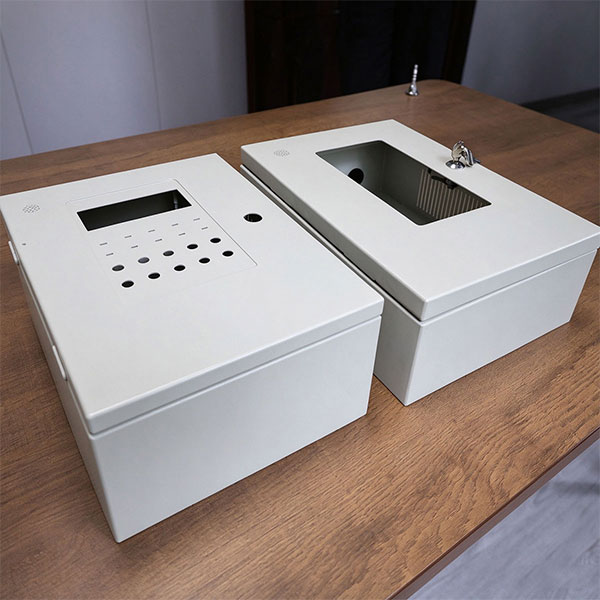
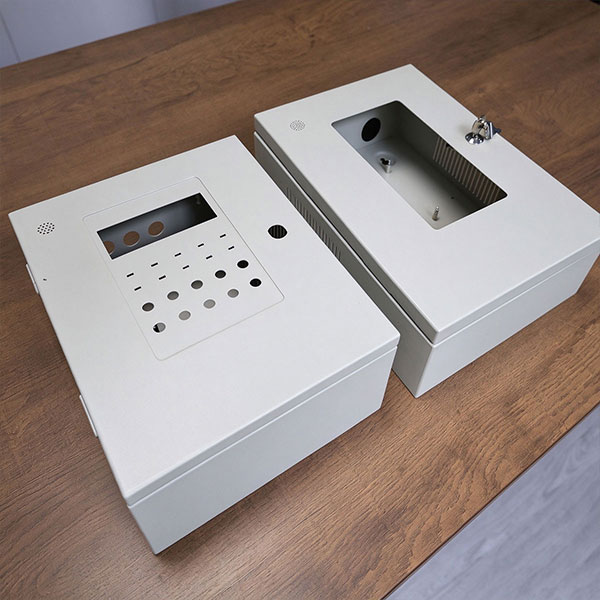
Carbon steel (typically cold-rolled SPCC or hot-rolled with pickled surface) is the default material for an industrial control panel cabinet in indoor, low-corrosivity environments. Sheet thickness for a steel industrial control panel cabinet typically ranges from 1.2 mm for small wall-mounted units to 2.0 mm or more for floor-standing enclosures that must carry heavy power equipment. Steel provides the best combination of stiffness, magnetic shielding, and cost of any material — which is why the majority of industrial control panel cabinets are steel.
The limitation of a steel industrial control panel cabinet is corrosion. Bare steel corrodes in most industrial atmospheres, so the steel substrate must be protected by a coating system. The common systems for an industrial control panel cabinet are: hot-dip galvanizing (zinc coating by immersion) for excellent corrosion protection at the cut edges; electroplating (zinc or nickel) for thinner, smoother coatings; and powder coating (electrostatic polymer powder cured by heat) which provides both corrosion protection and the colored finish most industrial control panel cabinets use. A steel industrial control panel cabinet in a C3 (moderate) or C4 (high) corrosivity environment requires a duplex system — galvanized substrate plus powder coat — to achieve a long service life.
When Carbon Steel Is the Right Industrial Control Panel Cabinet Material
A carbon steel industrial control panel cabinet is the correct choice for indoor installations in dry or moderately humid environments without chemical exposure — electrical rooms, machine enclosures on the factory floor away from wash-down, and control panels in warehouses and workshops. For these applications, a powder-coated steel industrial control panel cabinet delivers the required protection at the lowest cost. Selecting carbon steel for an industrial control panel cabinet in a wet, corrosive, or wash-down environment, however, is a mistake that coating alone cannot reliably fix.
Stainless Steel for Industrial Control Panel Cabinet
Stainless steel is the material for an industrial control panel cabinet in corrosive, hygienic, or outdoor environments. The corrosion resistance comes from a chromium oxide passive layer that reforms spontaneously when scratched — unlike paint, which cannot self-heal. The grades used for an industrial control panel cabinet are:
304 stainless steel — the general-purpose grade for an industrial control panel cabinet in indoor corrosive or food-adjacent environments. Adequate for most industrial atmospheres but susceptible to chloride pitting.
316 stainless steel — adds molybdenum for chloride resistance. Specified for an industrial control panel cabinet in coastal, marine, or de-icing salt environments where 304 would pit.
316L stainless steel — the low-carbon variant used for an industrial control panel cabinet in pharmaceutical and food processing where welding is extensive and intergranular corrosion must be avoided.
Duplex stainless steel (2205) — higher strength and corrosion resistance for an industrial control panel cabinet in aggressive chemical or offshore environments where standard austenitic grades are marginal.
A stainless steel industrial control panel cabinet costs roughly two to four times a comparable painted steel unit, but it eliminates the coating maintenance cycle and survives decades in environments that destroy coated steel within a few years. The lifecycle cost comparison frequently favors stainless for an industrial control panel cabinet in C4, C5, or CX corrosivity categories.
Hygiene and Food Applications for Industrial Control Panel Cabinet
In food, beverage, and pharmaceutical facilities, an industrial control panel cabinet must meet hygienic design principles — smooth surfaces, no crevices where bacteria harbor, and resistance to the aggressive cleaners used in sanitation. A stainless steel industrial control panel cabinet with a brushed or electropolished finish and IP69K rating (high-pressure, high-temperature wash-down per IEC 60529) is the standard for these applications. The electropolished surface of a stainless industrial control panel cabinet reduces bacterial adhesion and withstands frequent clean-in-place cycles that would strip paint from a steel cabinet.
Aluminum for Industrial Control Panel Cabinet
Aluminum is selected for an industrial control panel cabinet when weight is a constraint — rooftop installations, mobile equipment, or cabinets mounted on structures with limited load capacity. Aluminum is approximately one-third the density of steel, so an aluminum industrial control panel cabinet of equivalent size weighs dramatically less, reducing installation cost and structural support requirements. Aluminum also has excellent thermal conductivity, which helps dissipate heat from the cabinet interior, and forms a stable oxide layer that resists atmospheric corrosion without coating.
The trade-offs for an aluminum industrial control panel cabinet are: lower stiffness than steel (requiring thicker sections or ribbed construction for equivalent rigidity); non-magnetic properties (no magnetic field shielding, relevant for EMI-sensitive equipment); and galvanic corrosion risk when aluminum contacts dissimilar metals (such as steel fasteners or copper busbars) in a conductive electrolyte — requiring isolation washers or compatible fastener materials. An aluminum industrial control panel cabinet is the right choice when its weight and thermal advantages outweigh its cost premium and shielding limitations.
Polycarbonate and GRP for Industrial Control Panel Cabinet
Non-metallic materials — polycarbonate and glass-reinforced polyester (GRP) — are specified for an industrial control panel cabinet where metal is unsuitable. A polycarbonate industrial control panel cabinet is non-conductive, eliminating ground-fault and touch-risk concerns, and is transparent, allowing visual status checks without opening the door. A GRP industrial control panel cabinet (fiberglass-reinforced polyester) resists aggressive chemicals and high temperatures that degrade metals and coatings, making it the material of choice for an industrial control panel cabinet in chemical plants, wastewater treatment, and coastal installations with extreme corrosion.
The limitations of a non-metallic industrial control panel cabinet are mechanical strength and EMI shielding. Polycarbonate and GRP enclosures typically achieve lower IK impact ratings than metal and provide no electromagnetic shielding — so an industrial control panel cabinet housing EMI-sensitive electronics in a high-interference environment cannot use these materials without internal metal screening. A non-metallic industrial control panel cabinet is selected when corrosion resistance and electrical isolation dominate over mechanical and EMI requirements.
Coating and Finish Systems for Industrial Control Panel Cabinet
For a metal industrial control panel cabinet, the finish is part of the material system, not a cosmetic afterthought. The finish options are:
Powder coating — the standard finish for an industrial control panel cabinet, providing uniform coverage, good edge protection, and color options (typically RAL 7035 light grey or RAL 9005 black).
Hot-dip galvanizing — zinc coating for an industrial control panel cabinet in high-corrosivity outdoor environments, often combined with a powder topcoat (duplex system).
Electropolishing — for a stainless steel industrial control panel cabinet in hygienic applications, smoothing the surface and maximizing corrosion resistance.
Anodizing — for an aluminum industrial control panel cabinet, thickening the natural oxide layer for improved wear and corrosion resistance.
The coating specification for an industrial control panel cabinet should reference the corrosivity category of the installation (ISO 12944) and the expected maintenance interval. A coastal C5 environment demands a duplex system on a steel industrial control panel cabinet or 316 stainless; an indoor C2 environment is adequately served by a single powder coat on steel.
Material Selection Checklist for Industrial Control Panel Cabinet
The selection process for an industrial control panel cabinet material follows a structured sequence:
Define the installation environment — indoor/outdoor, corrosivity category, wash-down requirement, chemical exposure, UV exposure.
Define the mechanical requirement — IK rating, load, mounting method.
Define the EMC requirement — does the equipment inside need magnetic shielding (favoring steel) or is non-metallic acceptable?
Define the weight constraint — is aluminum required for installation feasibility?
Define the hygiene requirement — food/pharma drives stainless with hygienic finish.
Compare lifecycle cost — not just purchase price but coating maintenance, replacement interval, and downtime risk.
Applying this checklist to an industrial control panel cabinet specification prevents the two common failures: over-specifying stainless where coated steel is adequate (wasting budget) and under-specifying material where the environment demands stainless (causing premature failure).
Conclusion
Selecting the material for an industrial control panel cabinet is an environment-driven trade-off between corrosion resistance, mechanical protection, EMI shielding, weight, and lifecycle cost. Carbon steel with appropriate coating serves the majority of indoor industrial control panel cabinet applications at the lowest cost; stainless steel earns its premium in corrosive, hygienic, and outdoor environments where coating systems fail; aluminum is justified by weight and thermal advantages; and non-metallic materials serve the most aggressive chemical or electrical-isolation cases. The correct selection process starts with the installation environment and works through mechanical, EMC, weight, and hygiene requirements before comparing lifecycle cost. For an industrial control panel cabinet specification, state the ISO 12944 corrosivity category, the required IP and IK ratings, and the hygiene standard (where applicable) — these three inputs determine the material decision more than any other factor, and they let a qualified enclosure fabricator recommend the right material rather than the cheapest one.
FAQ
Is 304 or 316 stainless better for an industrial control panel cabinet near the coast?
For an industrial control panel cabinet in coastal or marine environments with chloride exposure, 316 stainless is the correct choice. 304 stainless is susceptible to chloride pitting in salt atmospheres and typically fails prematurely; 316's molybdenum content provides the chloride resistance required.
Can a powder-coated steel industrial control panel cabinet be used outdoors?
A powder-coated steel industrial control panel cabinet can be used outdoors only in low-corrosivity (C2–C3) environments. For C4–C5 outdoor or industrial atmospheres, a duplex system (galvanized plus powder coat) or stainless steel is required for acceptable service life.
Does an aluminum industrial control panel cabinet provide EMI shielding?
An aluminum industrial control panel cabinet provides some electromagnetic shielding through its conductivity but no magnetic field attenuation (aluminum is non-magnetic). For EMI-sensitive equipment requiring magnetic shielding, steel is the preferred material.
What finish is required for a stainless industrial control panel cabinet in food processing?
A stainless steel industrial control panel cabinet in food processing should use 316L with an electropolished or brushed finish and an IP69K rating to withstand high-pressure, high-temperature wash-down and meet hygienic design requirements.
References
1. ISO 12944-2:2017, "Paints and Varnishes — Corrosion Protection of Steel Structures by Protective Paint Systems — Part 2: Classification of Environments," International Organization for Standardization, Geneva, 2017.
2. IEC 60529:2013, "Degrees of Protection Provided by Enclosures (IP Code)," International Electrotechnical Commission, Geneva, 2013.
3. IEC 62262:2002, "Degrees of Protection Provided by Enclosures for Electrical Equipment Against External Mechanical Impacts (IK Code)," International Electrotechnical Commission, Geneva, 2002.
4. ASM Handbook Volume 13A: "Corrosion: Fundamentals, Testing, and Protection," ASM International, Materials Park, 2003.
5. NEMA 250-2020, "Enclosures for Electrical Equipment (1000 Volts Maximum)," National Electrical Manufacturers Association, Rosslyn, 2020.