

Choosing a pressure gauge sounds straightforward until you open a supplier catalog and face dozens of options that look identical from the outside but differ in ways that determine whether the gauge lasts six months or six years in your application. The pressure gauge selection decision is a system design problem — it requires matching the instrument's mechanical specification to the process conditions, understanding what the process medium will do to the gauge internals over time, and accounting for the consequences of a gauge failure. Getting pressure gauge selection right means the gauge provides accurate readings for its full service life without requiring premature replacement or, worse, failing in a way that creates a safety hazard. This pressure gauge selection guide covers the criteria that actually matter, in the order they should be evaluated.
Step One: Define the Pressure Range in Pressure Gauge Selection
The first and most consequential decision in pressure gauge selection is the pressure range — and with it, the appropriate full-scale range relative to normal operating pressure. The operating pressure of the system should fall between 25 and 75 percent of the gauge's full-scale range. This is not a suggestion — it is the practical working range within which the pressure gauge selection accuracy class applies. If normal operating pressure is 80 psi and you select a 100 psi gauge, the gauge operates at 80 percent of full scale — at the upper end of the acceptable range but acceptable. If the same system operates at 120 psi normal pressure and you use a 100 psi gauge, the gauge is routinely at full scale — a gauge not rated for that sustained overpressure — and will fail.
For pressure gauge selection, also consider the system pressure extremes: startup surges, valve slam, pump cycling, and thermal expansion events that can produce transient pressure spikes significantly above normal operating pressure. The selected gauge must have an overpressure rating — typically 1.3x or 1.5x full scale for steady overpressure and 2x or 3x for brief transients — that accommodates these system events without permanent damage to the pressure gauge selection mechanism. Gauges with lower overpressure ratings may yield permanently after a pressure spike, producing zero drift or broken Bourdon tubes.
Minimum and Maximum Pressure Range in Pressure Gauge Selection
The lower bound of the pressure gauge selection range is as important as the upper bound. A gauge selected for a system that normally operates at 500 psi but occasionally drops to 50 psi for maintenance purposes will spend most of its time in the lower 25 percent of its range, where its accuracy is worst relative to the reading. If pressure gauge selection requires monitoring both high and low pressure events, a compound gauge — measuring both pressure and vacuum in a single instrument — may be the appropriate pressure gauge selection solution. For systems where only knowing that pressure exists is sufficient — not the exact value — a switch-type pressure indicator with a fixed setpoint provides a lower-cost pressure gauge selection option than a full-range instrument.
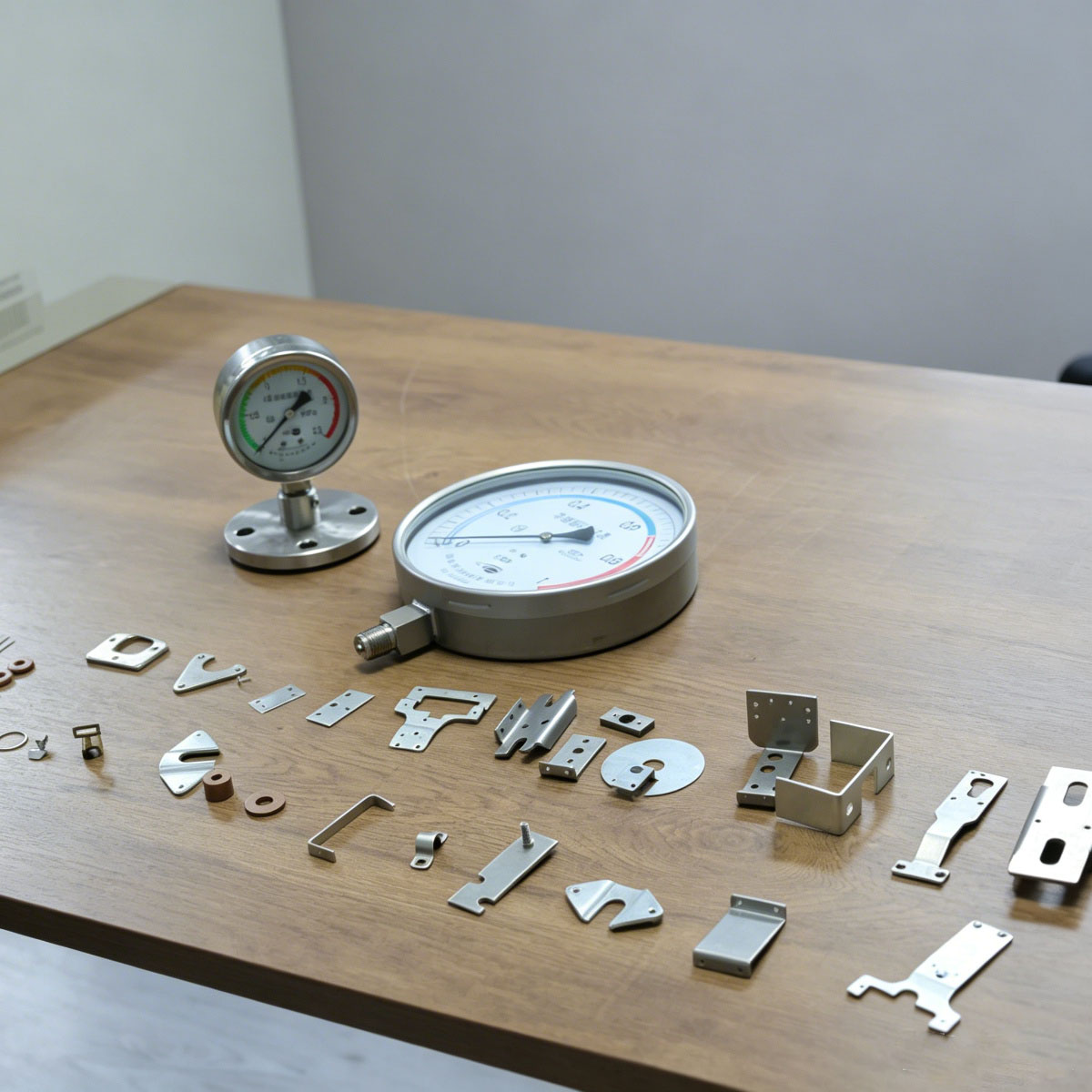
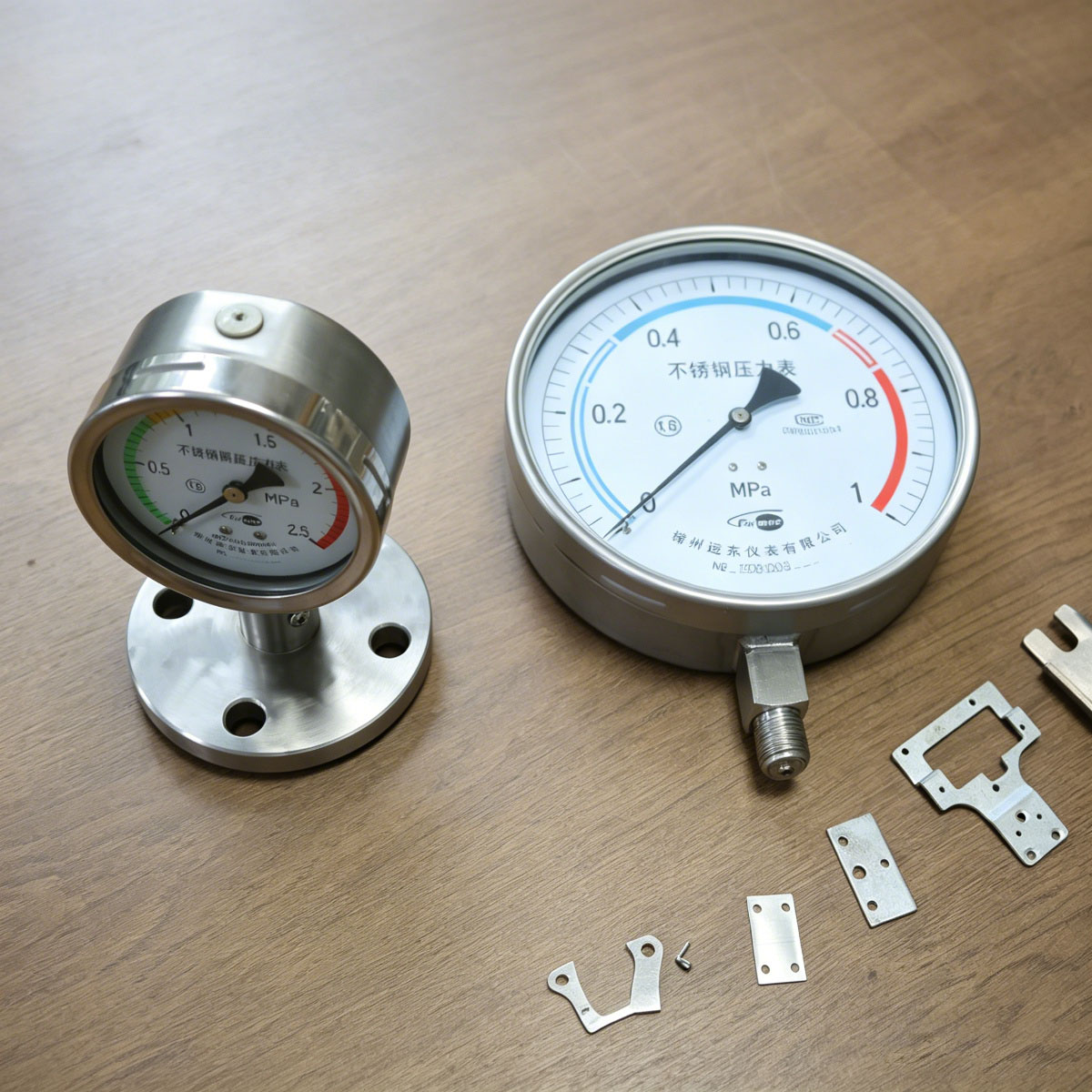
Step Two: Accuracy Class in Pressure Gauge Selection
The accuracy class in pressure gauge selection defines the maximum error across the full scale as a percentage of full scale — not a percentage of the actual reading. A Class 1.6 gauge (EN 837-1) on a 1,000 psi range has a maximum error of ±16 psi at any point on the dial. At 100 psi operating pressure, this represents a 16 percent relative error — potentially unacceptable. At 800 psi, it is a 2 percent relative error — acceptable for most general-purpose monitoring. This is why the accuracy class in pressure gauge selection must be evaluated against the actual operating pressure relative to full scale, not just against the nominal class value.
For pressure gauge selection in commercial transactions — where the pressure reading is used for billing, safety interlock setpoints, or regulatory compliance — the accuracy requirement is typically Class 1.0 or better (EN 837-1). For test and calibration applications, Class 0.25 or Class 0.1 is required. For general process monitoring where the reading is used for operational guidance rather than commercial or safety-critical determination, Class 2.0 or Class 2.5 is often acceptable at a lower pressure gauge selection cost. The temptation to select the lowest-cost gauge that meets the accuracy class is understandable — but the cost of incorrect pressure gauge selection is measured in process upsets, safety margin reductions, and replacement frequency.
Step Three: Process Media and Material Compatibility in Pressure Gauge Selection
The process medium is the most frequently underestimated factor in pressure gauge selection. A gauge that works perfectly in water service will fail rapidly in ammonia, chlorine, or hydrogen sulfide environments — not because the mechanism is wrong, but because the process fluid corrodes the Bourdon tube, clogs the pressure port, or attacks the seal materials. Pressure gauge selection must begin with a material compatibility review: what is the process fluid, what is its temperature, and does it contain corrosive constituents?
For pressure gauge selection, the primary material decision is the Bourdon tube and process connection material:
Brass/phosphor bronze — suitable for air, water, oil, and non-corrosive gases. Not suitable for ammonia, acetylene, or corrosive chemicals.
Stainless steel 316L — suitable for most corrosive media, steam, and high-purity applications. The standard pressure gauge selection for chemical, petrochemical, food processing, and pharmaceutical service.
Hastelloy C-276 — specified for highly corrosive media including chlorides, sour gas (H2S), and aggressive chemical process streams where 316L is inadequate.
Monel — used in seawater service, HF acid, and other highly corrosive applications where cost precludes Hastelloy.
Tantalum — the most corrosion-resistant option for pressure gauge selection in highly aggressive media including aqua regia, concentrated sulfuric acid, and other media that attack all other metallic wetted materials.
The fill fluid in diaphragm-sealed gauges is another pressure gauge selection material consideration: silicone oil is standard, but fluorinated fill fluid is required for oxygen service, and food-grade fill fluid for dairy and beverage applications. Using the wrong fill fluid creates a fire or contamination hazard that has killed people in oxygen system failures.
Step Four: Connection Type and Orientation in Pressure Gauge Selection
The process connection in pressure gauge selection — the thread size, thread type, and connection location — is determined by the installation point and the available process端口. The most common connection sizes are 1/4-inch and 1/2-inch NPT (National Pipe Thread) in North American practice, and G1/4 or G1/2 BSPP (British Standard Parallel Pipe) in European and Asian practice. The pressure gauge selection must match the existing process connection — and the thread type must be correct. NPT (tapered thread) seals by thread interference and requires thread sealant compound. BSPP (parallel thread) seals by a gasket face seal. Mixing NPT and BSPP connections produces leaks that are difficult to troubleshoot.
The connection location on the gauge — lower mount, lower back mount, or top mount — is a pressure gauge selection criterion determined by the physical layout of the installation. Panel-mounted gauges in control rooms typically use lower back connections to allow flush panel mounting with the dial facing forward. Pipe-mounted gauges typically use lower mount connections. For pressure gauge selection in tight spaces, a panel-mount gauge with a 90-degree connection can be oriented to read from any angle without re-plumbing the process connection.
Step Five: Environmental Conditions in Pressure Gauge Selection
The environment in which the pressure gauge selection operates — ambient temperature range, vibration level, weather exposure, and wash-down conditions — affects both the gauge mechanism and the dial readability over time. Ambient temperatures above 140°F or below 0°F degrade the pressure gauge selection accuracy through thermal effects on the spring element and the fill fluid. For outdoor pressure gauge selection in freeze-prone environments, a gauge with a siphon or an all-stainless construction with extended temperature rating prevents freeze damage. For marine pressure gauge selection, a marine-grade instrument with anti-corrosion treated case and moisture-resistant dial is specified to prevent condensation and salt spray ingress.
Vibration in the pressure gauge selection installation — common near pumps, compressors, and reciprocating equipment — causes pointer flutter, accelerates linkage wear, and fatigues the Bourdon tube. Gauges with liquid filling (glycerin or silicone oil damped cases) absorb vibration energy, reduce pointer flutter, and extend pressure gauge selection service life in high-vibration environments. The fill fluid dampens the pointer oscillation caused by system pressure pulsation and ambient vibration, providing both reading stability and mechanism protection. For extreme vibration environments, a bourdon tube gauge with a liquid-filled case is the pressure gauge selection standard recommendation.
Step Six: Regulatory and Certification Requirements in Pressure Gauge Selection
For pressure gauge selection in safety-critical applications — pressure equipment governed by PED 2014/68/EU in Europe, ASME Section VIII in the United States, or similar pressure equipment regulations globally — the gauge must be selected with regulatory compliance in mind. Safety-critical pressure gauge selection must use gauges with type approval from a Notified Body, marking the instrument as suitable for connection to pressure equipment. The pressure gauge selection must also include a syphon or equivalent device to prevent hot process media from reaching the gauge mechanism, as required by most pressure equipment standards.
For pressure gauge selection in hazardous areas — zones where flammable gases, vapors, or dusts are present — the instrument must carry the appropriate explosion-proof or intrinsically safe certification (ATEX, IECEx, or NEC 505/506). The pressure gauge selection in hazardous areas is not just a quality specification — it is a life safety requirement. Using an uncertified gauge in a hazardous area creates a potential ignition source that can cause a catastrophic explosion.
Pressure Gauge Selection Summary: The Decision Framework
Effective pressure gauge selection follows a sequential decision framework: start with the pressure range (operating pressure at 25-75% of full scale, with adequate overpressure margin), then the accuracy class (based on the consequence of measurement error), then material compatibility (matching wetted materials to the process fluid), then the connection type (matching existing process ports), then environmental conditions (temperature, vibration, weather), and finally regulatory requirements (PED, ATEX, or industry-specific standards). Skipping steps in pressure gauge selection — particularly material compatibility and overpressure margin — is the most common cause of premature gauge failure and the root cause of most pressure gauge-related safety incidents.
Conclusion
Pressure gauge selection is a problem of matching the instrument to the system — and the failure to do so correctly is the source of most pressure gauge problems in industrial service. The pressure gauge selection criteria that actually matter, in order of evaluation: the pressure range must accommodate both normal operating pressure and expected overpressure events; the accuracy class must be appropriate to the consequence of measurement error; the wetted materials must be compatible with the process medium; the connection type and orientation must fit the installation geometry; and the environmental conditions must not exceed the gauge's design envelope. A disciplined approach to pressure gauge selection — working through these criteria in sequence rather than defaulting to the lowest-cost option — produces instrument installations that provide reliable, accurate pressure readings throughout the service life of the equipment they monitor. When sourcing pressure gauge assemblies or components, work with a supplier who understands the pressure gauge selection criteria in this guide and can recommend material and configuration options for your specific process conditions.
FAQ
What pressure range should I select for my pressure gauge?
Pressure gauge selection should place normal operating pressure between 25 and 75 percent of the full-scale range. The selected gauge must also have an overpressure rating above the maximum expected system pressure, including transient events.
What accuracy class is needed for pressure gauge selection in process applications?
For general pressure gauge selection, Class 1.6 or Class 2.0 is acceptable. For commercial transactions, safety-critical applications, or regulatory compliance, Class 1.0 or better is required. For calibration applications, Class 0.25 or Class 0.1 is necessary.
What material is correct for pressure gauge selection in steam service?
For steam pressure gauge selection, a stainless steel Bourdon tube gauge with a pigtail siphon is standard. The siphon protects the gauge mechanism from live steam temperatures and provides pulsation dampening.
When should a diaphragm seal be included in pressure gauge selection?
Diaphragm seals are required in pressure gauge selection for corrosive,粘性, or particulate-laden media that would damage standard Bourdon tube internals, and for applications where the process media must not contact the gauge mechanism for contamination reasons.
What certifications are required for pressure gauge selection in hazardous areas?
Pressure gauge selection in hazardous areas requires ATEX or IECEx certification for European and international installations, or NEC Article 505/506 classification for US installations, confirming the instrument is approved for the specific zone classification.
References
1. EN 837-3:1996, "Pressure Gauges — Part 3: Diaphragm and Capsule Pressure Gauges," European Committee for Standardization, Brussels, 1996.
2. ASME B40.100-2013, "Pressure Gauges and Gauge Attachments," American Society of Mechanical Engineers, New York, 2013.
3. ASME Section VIII, Division 1, "Rules for Construction of Pressure Vessels," American Society of Mechanical Engineers, New York, 2019.
4. EU Directive 2014/68/EU (PED), "Harmonisation of the Laws of the Member States Relating to the Making Available on the Market of Pressure Equipment," European Parliament, Brussels, 2014.
5. IEC 60079-0:2017, "Explosive Atmospheres — Part 0: Equipment — General Requirements," International Electrotechnical Commission, Geneva, 2017.