

A sheet metal equipment cabinet looks simple from the outside — four walls, a door, some mounting hardware. The manufacturing process behind it is not simple. Producing a sheet metal equipment cabinet that holds its dimensions, seals against its environment, and survives years of industrial use requires a controlled sequence of cutting, forming, joining, finishing, and inspection operations, each with tolerances that accumulate across the assembly. For buyers sourcing a sheet metal equipment cabinet, understanding the production process is the most practical way to evaluate whether a supplier can deliver consistent quality or merely assemble flat panels. This article walks through the sheet metal equipment cabinet production process step by step.
Design and DFM for Sheet Metal Equipment Cabinet
The sheet metal equipment cabinet production process starts not on the shop floor but in engineering. The cabinet design is developed as a 3D model with associated 2D drawings specifying material, thickness, dimensions, tolerances, bend radii, and finish. Design for manufacturability (DFM) review optimizes the sheet metal equipment cabinet design for fabrication: minimizing the number of unique parts, standardizing bend radii to the press brake tooling, positioning holes outside the bend-affected zones, and avoiding features that require secondary operations. A sheet metal equipment cabinet designed with DFM reduces scrap, shortens lead time, and improves dimensional consistency — benefits that accrue across the entire production run.
Material Selection and Preparation
The sheet metal equipment cabinet material — typically cold-rolled steel (SPCC), hot-rolled steel, stainless steel (304/316), or aluminum (5052/6061) — is selected per the application's corrosion, strength, and weight requirements. Material arrives as sheet stock in standard sizes (for example 1250 × 2500 mm) and is verified against mill test reports for grade and thickness before production. For a sheet metal equipment cabinet in a corrosive environment, the incoming material is checked for coating or surface defects that would compromise the final finish. Material traceability — linking each production lot to the mill heat number — is part of the quality record for cabinets destined for regulated industries.
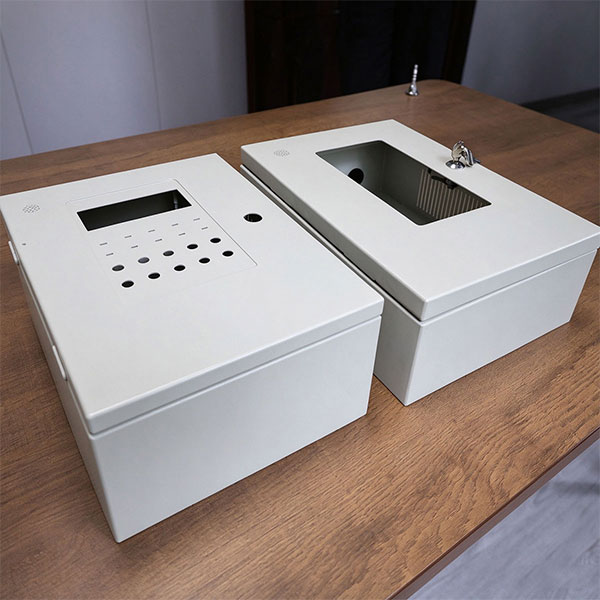
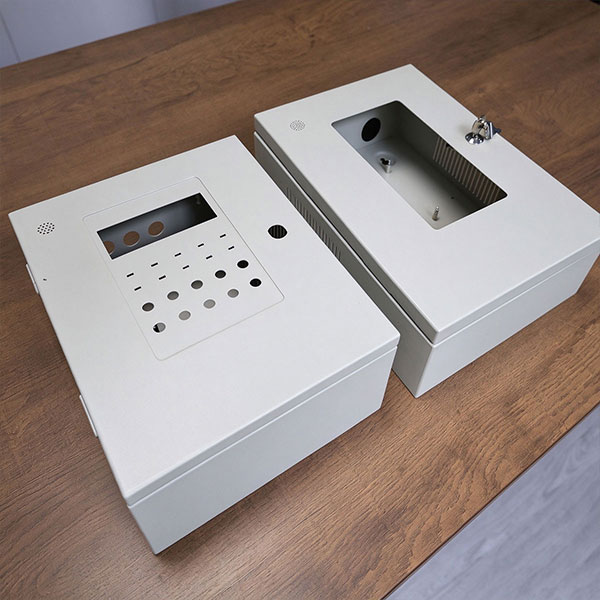
Cutting: Laser Cutting and CNC Punching for Sheet Metal Equipment Cabinet
The first shop-floor operation in sheet metal equipment cabinet production is cutting the flat blanks from sheet stock. Two technologies dominate:
Fiber laser cutting — uses a focused laser beam to cut the panel轮廓 with high edge quality and narrow kerf. Preferred for a sheet metal equipment cabinet with complex cutouts, louvres, and tight tolerances. Laser cutting leaves a clean edge requiring minimal deburring.
CNC turret punching — uses a rotating turret of punches and dies to cut and form features. Efficient for a sheet metal equipment cabinet with many repeated features (ventilation holes, embossments, tabs) because the turret forms these in the same operation as cutting, reducing secondary work.
The cutting operation for a sheet metal equipment cabinet must hold the blank dimensions within tolerance so that downstream bending produces parts that fit together. A capability statement from the supplier should specify the cutting tolerance (typically ±0.1 to ±0.2 mm for laser cutting) and the nesting efficiency, which affects material utilization and cost.
Bending: CNC Press Brake Forming for Sheet Metal Equipment Cabinet
After cutting, the flat blanks are formed into the cabinet's three-dimensional panels by bending on a CNC press brake. The sheet metal equipment cabinet side panels, top, bottom, and door are bent to the required angles using punches and dies matched to the material thickness and bend radius. Bending accuracy determines whether the panels assemble square — a sheet metal equipment cabinet with inconsistent bend angles will have misaligned doors, uneven gaps, and poor seal compression.
Bend Allowance and Springback in Sheet Metal Equipment Cabinet
Two phenomena govern bending accuracy for a sheet metal equipment cabinet: bend allowance (the material stretch at the bend, which determines the flat pattern length) and springback (the partial return of the material toward its original angle after the bending force is released). The press brake program compensates for springback by over-bending slightly; the compensation factor depends on the material, thickness, and bend radius. A sheet metal equipment cabinet manufacturer with calibrated press brakes and material-specific bend tables holds angle tolerance to approximately ±0.5 degrees, producing consistent panels across a production run. Without springback compensation, a sheet metal equipment cabinet will have cumulative dimensional drift that shows up as poor fit at assembly.
Joining: Welding and Fastening for Sheet Metal Equipment Cabinet
The formed panels of a sheet metal equipment cabinet are joined into a rigid structure by welding, riveting, or spot welding. Welding — typically MIG for steel and TIG for stainless and aluminum — produces a permanent, rigid joint suitable for the main cabinet body. For a sheet metal equipment cabinet, weld quality affects both appearance and structural integrity: excessive heat causes distortion; incomplete penetration weakens the joint; and spatter mars the surface that will later be finished. A skilled sheet metal equipment cabinet welder controls heat input and uses fixtures that hold the panels in position during welding to minimize distortion.
Some sheet metal equipment cabinet designs use self-clinching fasteners, rivets, or spot welds at specific joints to allow disassembly or to avoid heat distortion in thin material. The joining method for a sheet metal equipment cabinet is selected based on the structural load, the material, and whether the joint must be serviceable. After joining, the welded sheet metal equipment cabinet structure is checked for squareness and dimensional accuracy before finishing — correcting distortion at this stage is far cheaper than after powder coating.
Surface Treatment for Sheet Metal Equipment Cabinet
The finish of a sheet metal equipment cabinet protects the metal and determines its appearance and corrosion life. The typical sequence is:
Degreasing and cleaning — removes cutting fluids, oils, and contaminants from the sheet metal equipment cabinet surface so the coating adheres.
Surface preparation — phosphating or chromating (or a non-chrome alternative) creates a conversion coating that improves paint adhesion and corrosion resistance on a steel sheet metal equipment cabinet.
Powder coating — electrostatically applied polymer powder cured in an oven, providing a uniform, durable finish. The standard color for a sheet metal equipment cabinet is RAL 7035 grey or RAL 9005 black.
Galvanizing (optional) — hot-dip or electroplated zinc for a sheet metal equipment cabinet in high-corrosivity environments, often under the powder coat as a duplex system.
For a stainless steel sheet metal equipment cabinet, the finish may be brushed, bead-blasted, or electropolished rather than coated, since stainless does not require paint for corrosion protection. The finish specification for a sheet metal equipment cabinet should reference the corrosivity category (ISO 12944) of the installation to ensure the coating system is adequate.
Hardware and Sub-Assembly in Sheet Metal Equipment Cabinet
After finishing, the sheet metal equipment cabinet receives its hardware: hinges, locks, handles, gaskets, mounting rails, and cable glands. The gasket installation is critical — the gasket in a sheet metal equipment cabinet must be compressed within its specified range to achieve the rated IP protection; under-compression leaks, over-compression causes permanent set. The door and hardware are fitted and adjusted so the door closes squarely with even gaps and the lock engages. A sheet metal equipment cabinet with poorly fitted hardware will have door seal leaks and a door that does not latch reliably — failures that appear only after installation.
Quality Inspection for Sheet Metal Equipment Cabinet
The sheet metal equipment cabinet production process ends with inspection, which should occur at multiple points rather than only at the end. In-process inspection checks cut dimensions, bend angles, and weld quality during production. Final inspection verifies the completed sheet metal equipment cabinet against the drawing: overall dimensions and squareness, door fit and seal compression, hardware function, finish quality (coating thickness, adhesion, appearance), and IP rating verification where required. A sheet metal equipment cabinet supplier with a documented inspection procedure — and records from previous inspections — demonstrates the process control that consistent quality depends on.
Dimensional and Functional Testing of Sheet Metal Equipment Cabinet
Depending on the application, a sheet metal equipment cabinet may undergo additional verification: dimensional first-article inspection (FAI) against the drawing for new or changed designs; IP ingress testing per IEC 60529 for enclosures with a specified protection rating; IK impact testing per IEC 62262 for cabinets with a mechanical protection rating; and ground continuity testing for electrical enclosures. A sheet metal equipment cabinet supplier that provides test documentation from comparable work gives the buyer evidence that the process delivers conforming product, not just a plausible sample.
Evaluating a Sheet Metal Equipment Cabinet Manufacturer
The production process described above is the lens through which to evaluate a sheet metal equipment cabinet supplier. The key questions are: Does the supplier have in-house cutting, bending, welding, and finishing (or a controlled subcontractor for finishing)? Can the supplier hold the dimensional tolerances the design requires, and provide FAI evidence? Does the supplier have a documented welding procedure and operator qualifications? Can the supplier provide coating thickness and adhesion data? Does the supplier perform in-process and final inspection with records? A sheet metal equipment cabinet supplier that answers these affirmatively with documentation is a manufacturing partner; one that cannot is a job shop whose output varies with whoever is on the floor that day.
Conclusion
The sheet metal equipment cabinet production process is a controlled sequence — design and DFM, material preparation, laser cutting or CNC punching, CNC bending with springback compensation, welding or fastening, surface treatment, hardware fitting, and multi-stage inspection — in which dimensional accuracy at each step accumulates into the fit, seal, and durability of the finished cabinet. Understanding this process lets a buyer evaluate a sheet metal equipment cabinet supplier on the right criteria: in-house capability across the process chain, dimensional control with FAI evidence, documented welding and finishing procedures, and inspection records that prove conformance. A sheet metal equipment cabinet from a supplier with this discipline fits together, seals correctly, and survives its environment; one from a supplier without it looks similar on the showroom floor and fails in service. When sourcing a sheet metal equipment cabinet, ask for the supplier's process flow, their typical cutting and bending tolerances, and FAI documentation from a comparable cabinet — the answers reveal more about the product you will receive than any price quotation.
FAQ
What is the typical tolerance for laser cutting in sheet metal equipment cabinet production?
Laser cutting for a sheet metal equipment cabinet typically holds ±0.1 to ±0.2 mm on blank dimensions. This accuracy matters because cutting tolerance feeds directly into bending and assembly fit of the finished sheet metal equipment cabinet.
Why does springback matter in sheet metal equipment cabinet bending?
Springback — the partial elastic recovery of metal after bending — causes a sheet metal equipment cabinet panel to return toward its original angle. Without press brake compensation, cumulative angle drift produces misaligned doors and poor seal compression. Material-specific bend tables correct for it.
What surface treatment is standard for a sheet metal equipment cabinet?
The standard finish for a steel sheet metal equipment cabinet is degreasing, conversion coating (phosphating or chromate alternative), and powder coating (typically RAL 7035 or RAL 9005). High-corrosivity environments use a galvanized duplex system under the powder coat.
How is IP rating verified on a sheet metal equipment cabinet?
A sheet metal equipment cabinet with a specified IP rating is verified per IEC 60529 through dust-ingress and water-jet testing at the rated levels. The result depends on correct gasket material, groove design, and compression — verified during production inspection.
References
1. ISO 9013:2017, "Thermal Cutting Processes — Classification of Thermal Cuts — Geometrical Product Specification and Quality Tolerances," International Organization for Standardization, Geneva, 2017.
2. ISO 12944-2:2017, "Paints and Varnishes — Corrosion Protection of Steel Structures by Protective Paint Systems — Part 2: Classification of Environments," International Organization for Standardization, Geneva, 2017.
3. IEC 60529:2013, "Degrees of Protection Provided by Enclosures (IP Code)," International Electrotechnical Commission, Geneva, 2013.
4. Kalpakjian, S. and Schmid, S.R., "Manufacturing Engineering and Technology," 7th Edition, Pearson, Upper Saddle River, 2017.
5. AWS D1.1/D1.1M:2020, "Structural Welding Code — Steel," American Welding Society, Miami, 2020.